Guide contents
Categories
How big a market is — what was bought under each category, by whom, and what is open now, in UNSPSC, the states' own labels and GrantConnect's.
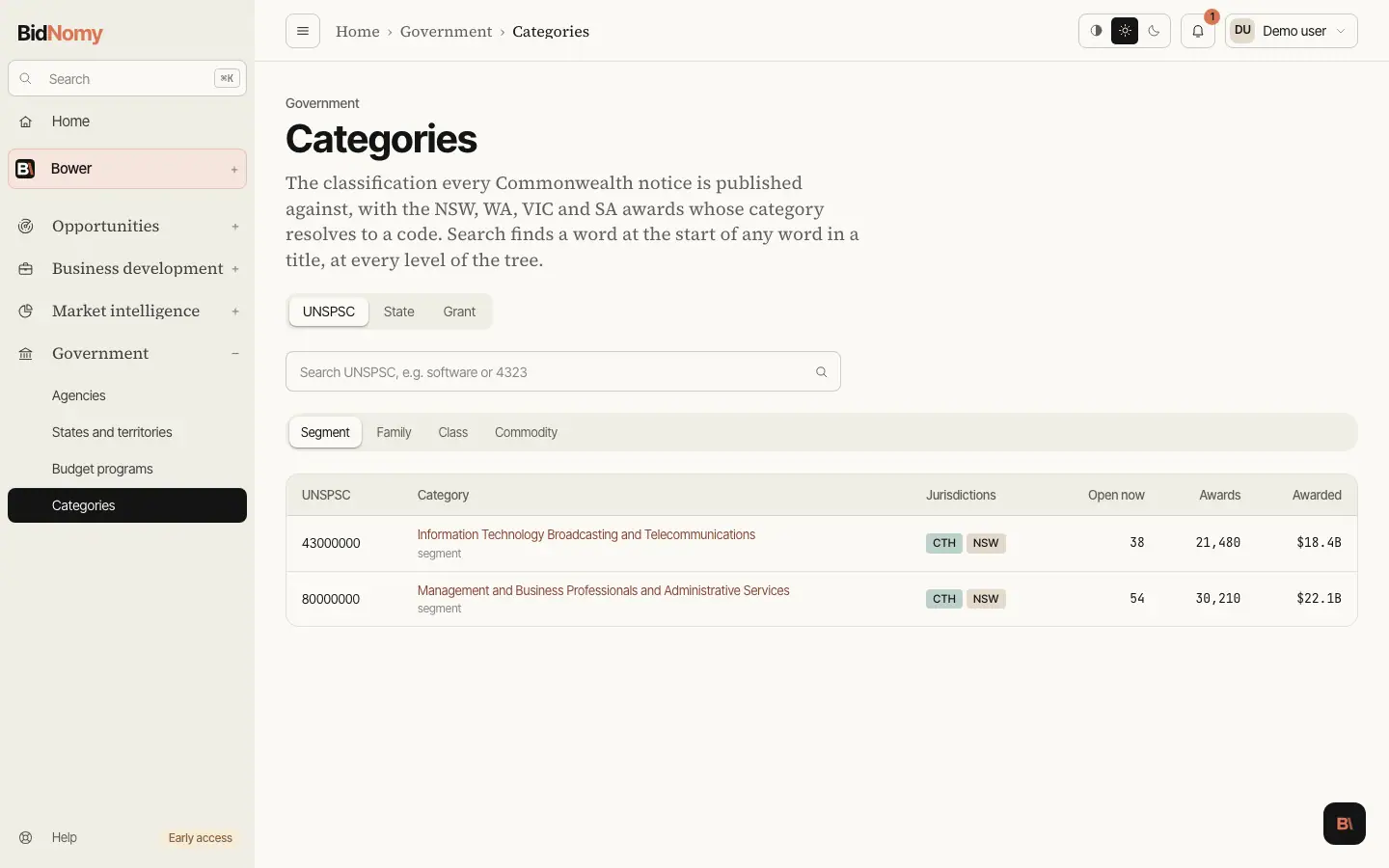
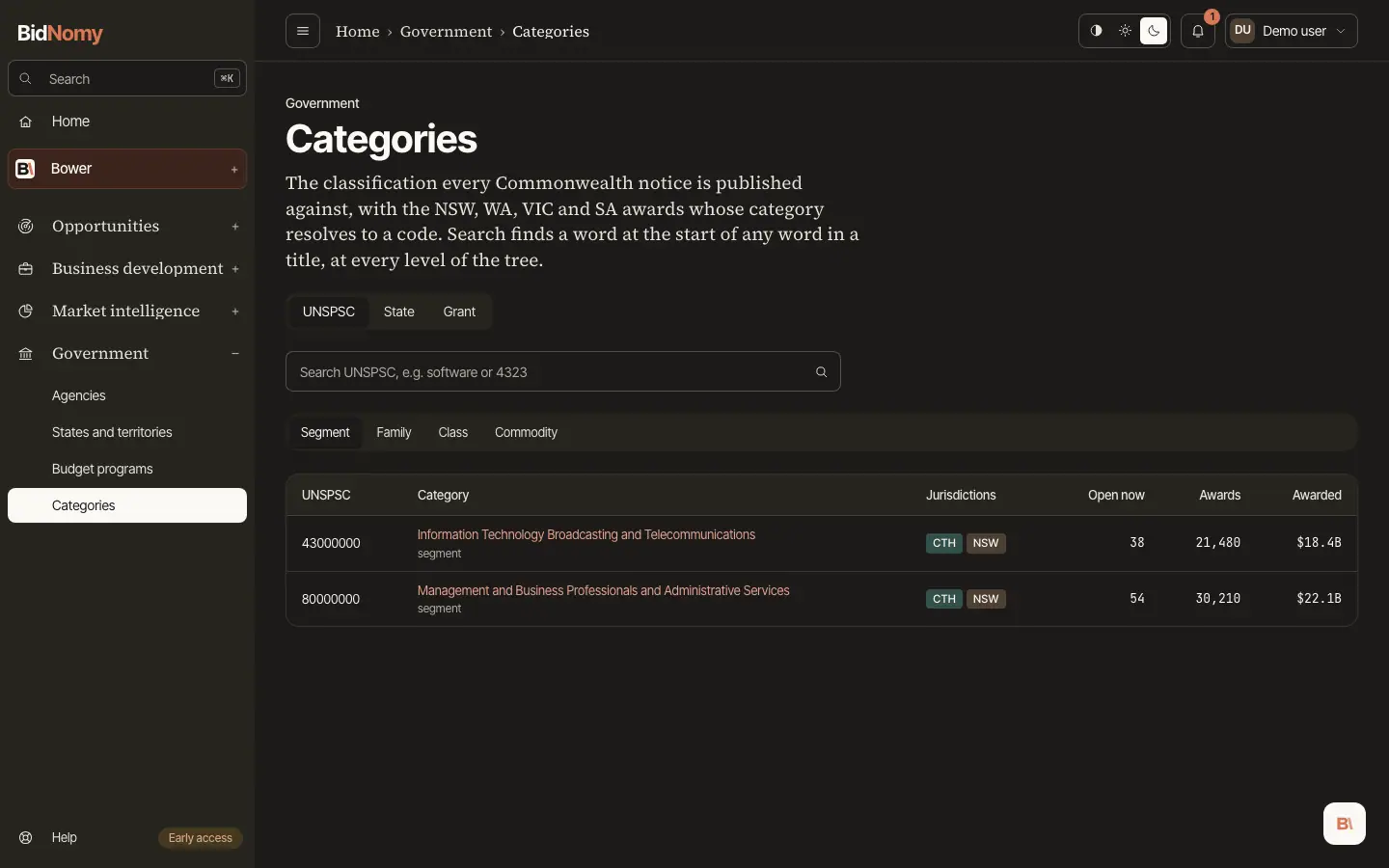
Status. UNSPSC, State categories (QLD, NT, ACT, TAS) and Grant categories are live, each with a list you can search and a page per category.
Categories, under Government in the sidebar, answers one question: how big is this market for me? It has three tabs, UNSPSC, State and Grant, one per scheme below. Every category has a page with the number of opportunities open now, the awards and the value awarded in the last twelve months, the suppliers active in them, awards by financial year, the biggest buyers and the biggest suppliers, and the categories beside it. Every section links to the matching list (contracts, open tenders, Market size) with the category filter already set.
Three schemes, because governments publish in three
UNSPSC (the first tab). Every AusTender notice carries a UNSPSC code, from segment (two digits) down to commodity (eight). The UNSPSC list is the whole tree: choose a level, or search, and every level is searched at once. Each level is listed in code order, lowest code first; a search lists the best matches first. Only categories something was contracted under are listed. As you type, the box offers the matches to open directly; Enter still lists them. Search matches the start of a word, so "ict" finds "ICT" and not "Friction". A number matches the start of a code: "43" or "430" finds every category under segment 43; "4323" finds the Software family and what is under it. UNSPSC has its own vocabulary: "cyber" is in no UNSPSC description, but "security" is. New South Wales, Western Australia, Victoria and South Australia publish categories that resolve to UNSPSC codes, so their awards are counted on the UNSPSC pages too, for the states your plan includes.
State categories (the State tab). Queensland, the Northern Territory, the ACT and Tasmania publish their own category labels on their awards, and those labels resolve to no UNSPSC code. Each label is its publisher's own vocabulary, so the same words in two states are two categories. A label's page shows where another of the four publishes the same label. These labels need a plan that includes those states.
Grant categories (the Grant tab). GrantConnect classifies grant opportunities and grant awards in its own list, which is not UNSPSC. A grant category's page counts each grant once, at its latest version. Grant amounts are never added to contract values.
The ACT crosswalk
The ACT publishes UNSPSC titles as its category labels. So when an ACT label is exactly a UNSPSC description (case and spacing aside), the two pages link to each other: the UNSPSC page says "Also published as ACT category …" and the ACT page names the UNSPSC node. Only an exact title match counts. Queensland and the Northern Territory get no crosswalk, because their labels are not UNSPSC titles and any match would be a guess.
What the numbers are
- Open opportunities: Commonwealth approaches to market on a UNSPSC page, because state tenders carry no code. Open state tenders under the label on a state page. Open grant opportunities, ongoing ones included, on a grant page.
- Awards and value, last twelve months: value at award, not spend to date. A state's value is as the state publishes it.
- Suppliers active: supplier groups on a UNSPSC page. On a state page, supplier names as published, so one company can appear under two spellings. Recipients on a grant page.
- A dash means the figure could not be read. It never means zero.