Guide contents
Contracts
Awarded contracts. ACT payments sit on their own tab.
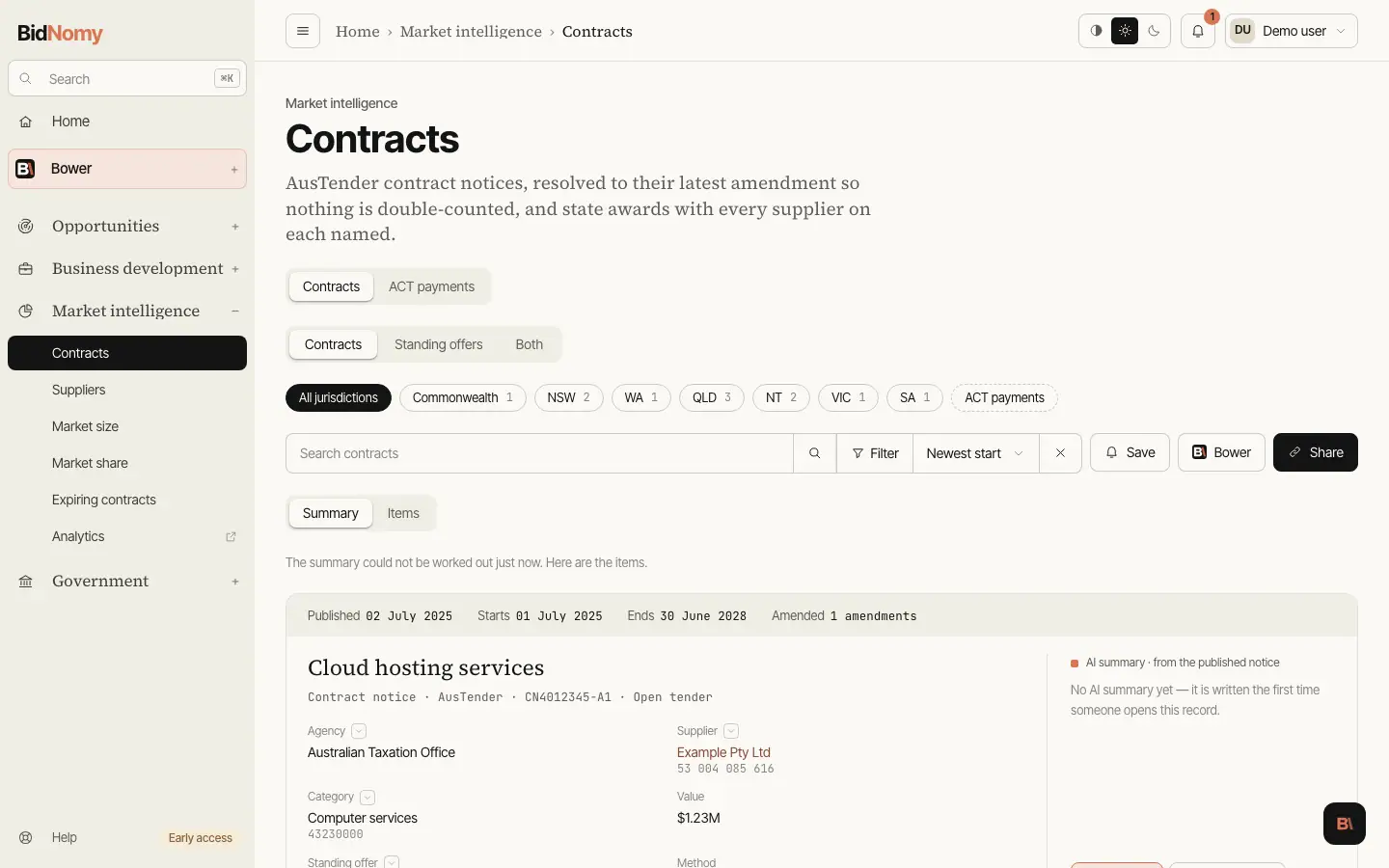
Contracts
Contracts is the most useful list in Australian government contracting, because the Commonwealth publishes what it actually bought. Contract notices run from 2007 to today, each with the buying entity, the supplier and its ABN, the procurement method, the value and — critically — the end date, which is what makes Expiring contracts possible at all. Panel awards list the suppliers appointed to each standing offer, and a contract notice names the standing offer it was drawn from, so Contracts can be narrowed to one panel's work. Grant awards and panel places each open a record page of their own.
One detail governs everything here. AusTender publishes one row per publication event: the original notice, then each amendment as its own row carrying cumulative values. Summing them raw double-counts, sometimes severely. Every figure in this product resolves a notice to its latest version first, and the row you see is the contract as it stands today, with its amendment count shown beside it.
The Contracts summary
Contracts opens on a summary of whatever the tab, the chips, the search and the filters select. Items beside Summary is the list itself, with exactly how many contracts it holds; the choice stays in the address.
- Four figures — how many contracts, with how many started in the last 12 months; their total value and median, and how many state a value; how many suppliers, with the biggest; how many buyers, with the biggest. Click a figure, or the line under it, to open Items holding exactly those contracts (total value opens them largest first).
- Charts — by category, the top buyers, the top suppliers, and value by month of start. Click a bar to narrow to it. A chart that would repeat the cards below, or a choice you have already made, is left out. Where Commonwealth and state categories sit in one chart, each bar says which it is (· Commonwealth, · states), because the two lists can share a name.
- Largest contracts and How it was bought — the share of the value by procurement method: open, selective, limited, and other or unstated (a method the publisher left blank or described in words that don't say which).
- Cards — by jurisdiction, then by category once you pick one, then by buyer. Click a card to narrow to it.
The rules are the list's. Amended notices count once, at their latest version. Standing offers are counted, never summed: their value is a ceiling, so on the Both tab the figures add up contracts only and say how many standing offers there are, and the Standing offers tab shows no total. A state award shared by several suppliers gives each its own share. ACT payments are never in these figures — they are their own tab.
The figures at the top
The Market intelligence page opens with four Commonwealth figures, refreshed hourly. Each one opens what it counts.
- Contracted — the value of contract notices published this month so far, beside the same days of last month. Opens Contracts. An amended contract counts in the month of its latest amendment.
- Largest this month — the biggest contract published this month. Opens the contract.
- Panels refreshed — panels that added supplier places in the last 30 days, with the places added and the new standing offers. Opens Panels › Awarded, newest first.
- Grants awarded — grants first awarded this month and the program with the most money. Opens Grants › Awarded.
Under the figures
- Re-compete radar — Commonwealth contracts ending in the next 90, 180 or 365 days, soonest first, with the agency, the incumbent, the value, the end date and the months left. Track adds the contract to your pipeline as Add to pipeline does on its page. See all opens Expiring contracts with the same window.
- Who's winning by quarter — the top three supplier groups by value in each of the last four calendar quarters, newest first, from Commonwealth contracts by the month they were published. The current quarter is marked so far. Opens the supplier.
- Who's winning — the biggest supplier groups in the last complete financial year, from Market share.
- First-time winners — supplier groups whose first Commonwealth contract fell in that year, with their biggest buyer.
- Latest contracts — the newest contract notices and state awards.
State awards
State awards are in Contracts, beside the AusTender contract notices, with a row of jurisdiction chips above the list — Commonwealth is one chip and each state another. Each card says which it is ("Contract notice · AusTender", "State award · Tenders WA"), because a state notice is not an AusTender one. Several jurisdictions are connected and none of them is the same thing. New South Wales carries an archive of contracts and standing offers alongside its tenders, schemes and forward plans. Western Australia's awards are its contracts and standing offers from Tenders WA: the open-data files (award dates July 2021 to June 2024, CC BY 4.0) plus newer awards from the live Tenders WA register, used with written permission and refreshed weekly. Awards from July 2024 onwards are still being back-filled, so that period may be incomplete for now. Queensland's awards are its agencies' own contract disclosure reports. The Northern Territory's are its awarded tenders and quotes from Quotations and Tenders Online, from November 2010. The Australian Capital Territory's awards are its live Contracts Register, used with written permission, plus its 2000-2017 registers under CC BY; its tenders and Advance Tender Notices are under Opportunities. Tasmania's are the awarded contracts from Tasmanian Government Tenders, used with written permission; they name no supplier ABN, and each carries Tasmania's own category label rather than a UNSPSC code. Every state's current tenders and forward plans — WA's and Queensland's included — are under Opportunities, not here: a tender that has been awarded stays a tender, with its status saying so.
What a state publishes also differs from what the Commonwealth does, and the page shows the difference rather than filling it in. WA publishes no supplier ABN, no status and no GST flag, so a WA award names its supplier as plain text, shows no status line and labels its figure plainly. It does publish two things AusTender does not: how many offers the buyer received — where none is a real answer — and whether the value is an estimate or the agreed price, which is why a WA figure may read Value (estimate). Every state record, and every export holding one, carries the publisher's attribution line shown verbatim. State coverage is included from Pro up, and in the trial.
State standing offers are counted, never added to a value. A state standing offer — a panel, a standing offer arrangement, a common-use arrangement — states a ceiling to buy from, and what an agency buys under it is published as a contract of its own. Adding the two would count the same money twice, so every value total in the product is contract awards only, and standing offers are given beside it as a count: Market size, Market share and Expiring contracts, and a supplier's State awards figure, which reads "contracts · value · standing offers". The Standing offers tab still lists every one of them, and a standing offer's own page still shows the value it states. It is the same reason the Commonwealth's standing offers are not in any contract total.
The ACT is the one jurisdiction here that also has a tab of its own: alongside its contracts it publishes the Notifiable Invoices Register, invoices it has paid rather than awards — the ACT payments tab of Contracts — counted as payments and added to no award figure anywhere.
Queensland's awarded contracts
Queensland does not run a central award register. Every agency publishes its own contract disclosure report on data.qld.gov.au — awarded contracts of A$10,000 and over, one dataset per agency per year or so, 370 datasets from 67 organisations — and those are what the Queensland rows on this page are. They are open data, but not under one licence: most datasets are CC BY 4.0 and a handful are CC BY 3.0 AU, so the attribution line travels with the row and is the line shown beside it.
Read a Queensland count as a floor, never a total. Contracts under A$10,000 are not disclosed at all, and the agencies that publish in Excel alone are not loaded — so there is more than you can see. In the other direction, where an agency publishes no reference number a contract whose value was later varied can appear twice, so there is sometimes less than the row count suggests. This product therefore never presents a Queensland total spend, and neither should a report built from these rows.
Queensland publishes less per contract than NSW does. There is no GST flag, no status, no count of offers received and no estimate-or-fixed-price basis, and roughly half the agencies publish no supplier ABN — Health and most departments do, Police and Treasury do not. Those lines are left off the page rather than shown as dashes. The Source link on a Queensland award opens the agency's disclosure report, because no page about the individual contract exists.
Victoria and South Australia
Victoria and South Australia publish their contracts on the same kind of site, one state apart: Buying for Victoria (Tenders VIC) and SA Tenders and Contracts, where every agency discloses each contract it lets on a page of its own. Both registers are here with each publisher's written permission, and each row carries the publisher's attribution line — "Source: State of Victoria, Buying for Victoria / Tenders VIC (www.tenders.vic.gov.au), used with written permission" and "Source: Government of South Australia, SA Tenders and Contracts (www.tenders.sa.gov.au), used with written permission". Their open tenders and advance tender notices are under Opportunities. The Source link on either opens the contract's own page on the publisher's site.
Victoria publishes no award or publication date. A Victorian contract is dated, ordered and filtered by its start date, and its record page says the publication date was not published rather than leaving a blank. Victoria also does not say whether its figures include GST, so a Victorian value is never labelled either way; it reads Value (estimate) where the publisher marked the figure an estimate. About seven in ten Victorian contracts name a supplier ABN.
South Australian values include GST, so they read Value (incl. GST), and a contract is dated by the day it was executed. The register publishes no supplier ABN, so a South Australian supplier is named as plain text, as a WA one is.